A healthy smile, lasting results
A healthy smile strengthens your confidence and success in everyday life. A condition for the long-term success of our work is your beautiful and healthy smile.
The basis of this is that our patients learn the brushing technique appropriate to their case, which our individual oral hygiene program provides. Numerous scientific studies have proven that the presence of tartar and gingivitis also has health- and tooth-damaging effects: it can cause heart disease, focal diseases (hair loss, skin inflammations, gynaecological inflammations, eye diseases, etc.) and even premature birth.
The individual oral hygiene program is designed jointly by the specialist dentist and the dental hygienist. Since every case is different, only a personalised program can be thorough enough to support the long-term maintenance of a healthy periodontium. During this, we draw the patient's attention to the hard-to-clean “critical” areas that have from time to time caused recurring inflammatory complaints.
The individual oral hygiene program
The dental hygienist colleagues working in our clinic perfect their knowledge in special iTOP (Individually Trained Oral Prophylaxis) courses, so that they can provide our patients with the most modern oral care advice. The dental hygienist demonstrates and teaches the proper brushing technique and the tools of professional oral hygiene, and helps you choose the right toothbrush, dental floss, cleaning floss for under restorations, special brushes for cleaning implants, an electric toothbrush and a mouthwash.
What exactly is tartar?
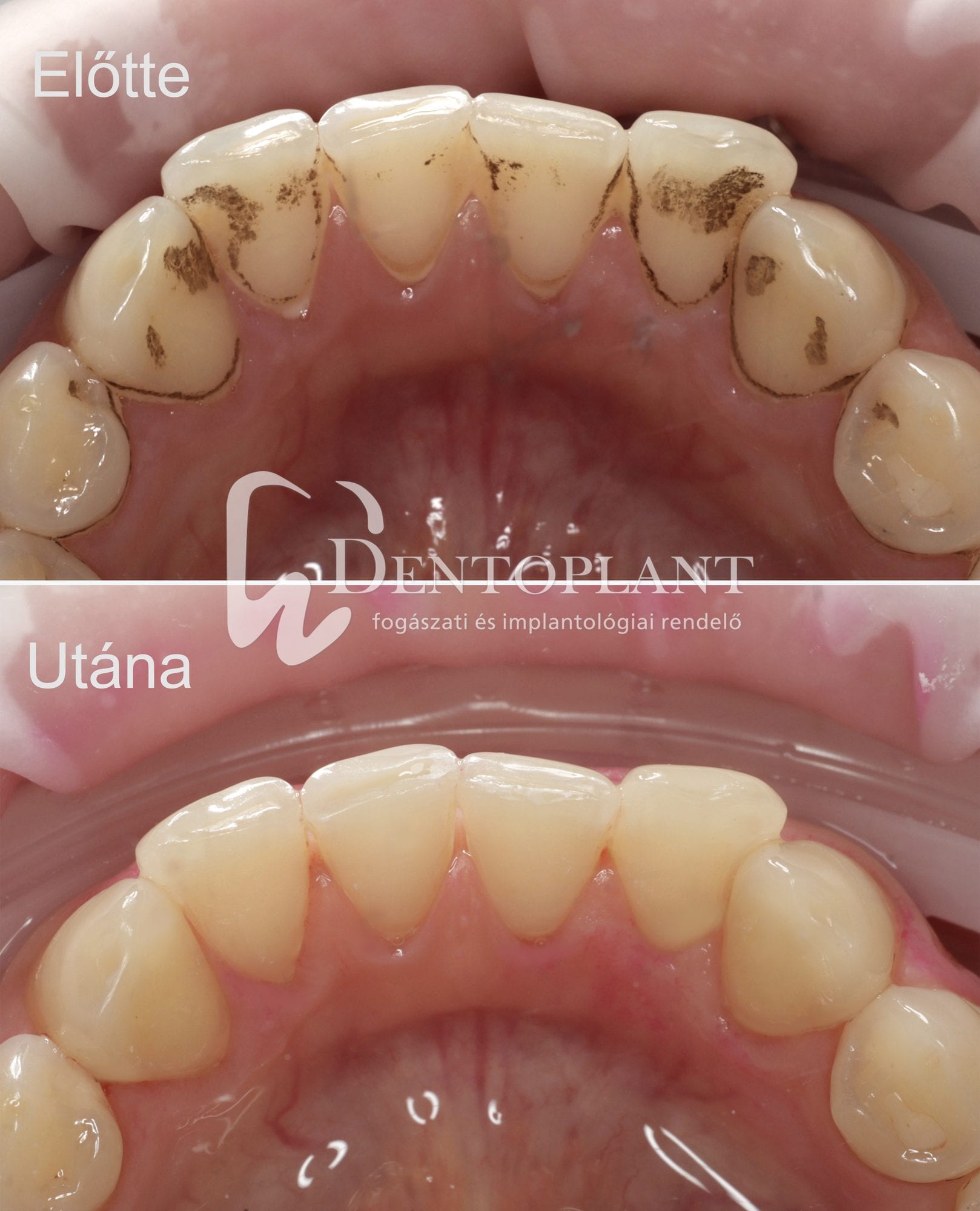
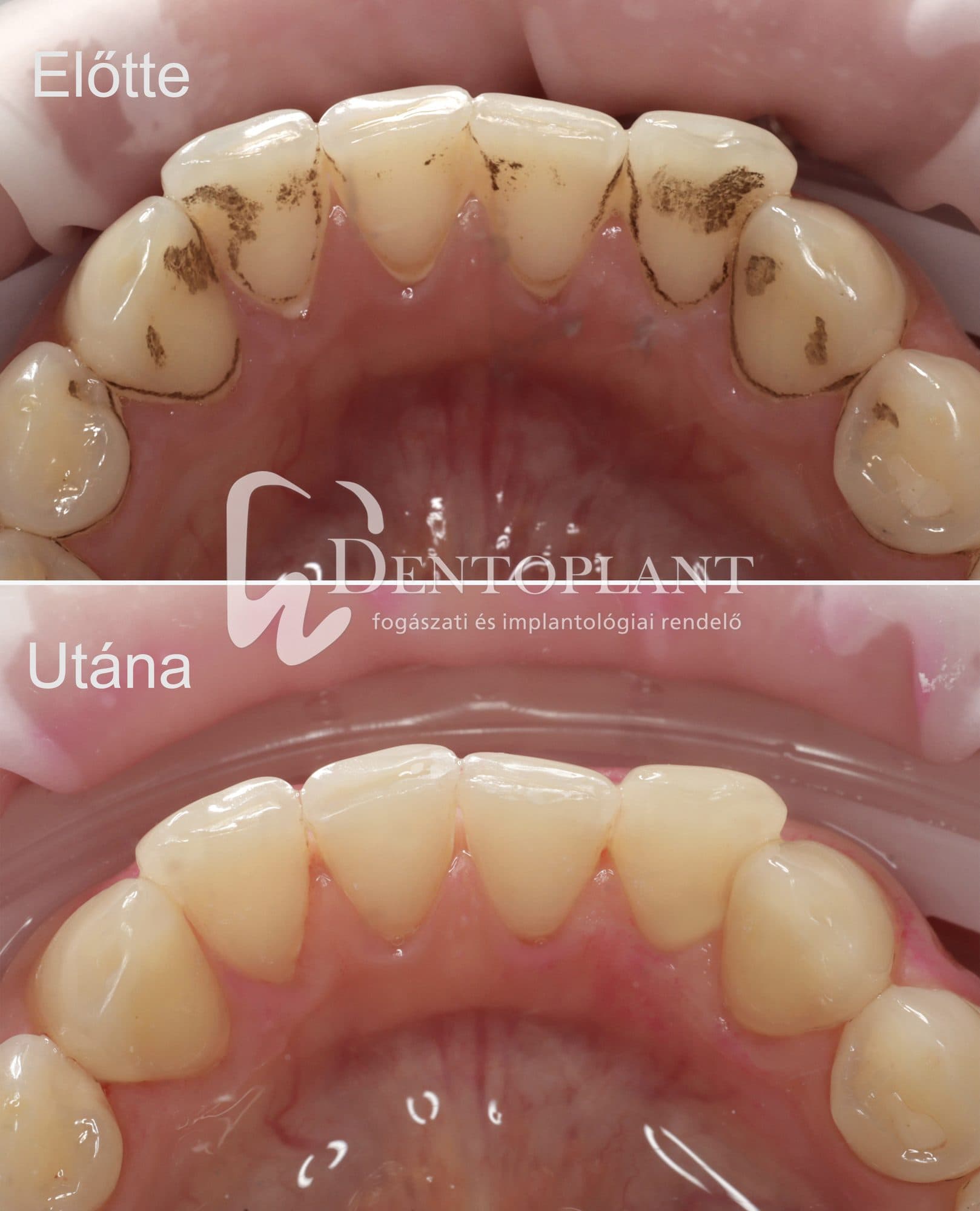
Tartar is calcified dental plaque. When plaque is not fully removed from the teeth, over time lime crystals from the saliva deposit into it and tartar forms. Tartar adheres to the tooth so strongly that it cannot be removed by simple brushing — only a professional (dentist, dental hygienist) can clean it off properly.
Tartar is a yellowish-brown deposit that most often forms on the tongue-side surface of the lower incisors and the cheek-side of the upper molars, because this is where the ducts of the large salivary glands are located. The colour of tartar is caused by pigments from the metabolic products of numerous bacteria, blood pigment, or external pigments (caffeine, nicotine, cola).
Why is it worth taking tartar seriously?
- By irritating the gums, tartar can cause gingivitis and sustain the inflammation.
- Long-standing inflammation can cause periodontal disease, bone loss, loosening and then loss of the teeth.
- Tartar looks aesthetically unpleasant and gives an unkempt impression.
- Tartar can discolour the teeth and contributes to the development of unpleasant breath odour.
Tools you can use at home
Which toothbrush should we choose?
A good toothbrush is simple, of medium or soft bristle strength, made of dense bristles and with a smaller head. It is important that the ends of the plastic bristles are rounded, so they do not fray and do not injure the periodontium. With versions that have complex head shapes and flexible necks, the cleaning, sweeping movements cannot be directed accurately enough — the simpler, the better.
Among electric toothbrushes, we recommend the version with a smaller round head performing a back-and-forth rotating movement; a softer “sensitive” head is also available for it. A single-tuft toothbrush is suitable for precise interdental cleaning, but its use is time-consuming. The correct brushing technique is at least as important as the toothbrush itself.
When should we replace the toothbrush?
In general, every 3 months is recommended. A used toothbrush has an average of 1.2 million bacteria on it. It is important to store the toothbrush so that it can dry out thoroughly every day — a moist environment is favourable for bacteria. If a cold, flu or contagious illness appears in the family, every toothbrush must be replaced afterwards.
Dental floss and interdental brush
Traditional dental floss: used to remove plaque between adjacent teeth. Its use has to be learned separately — it can be especially useful in areas of crowded front teeth. Tear off at least 50 cm for a thorough cleaning, and always guide clean floss between the teeth, moving it outwards.
Special flosses: for cleaning under restorations, for implants and between splinted teeth we use versions of different thickness that stand up as individual strands.
Interdental brush: for cleaning the adjacent surfaces of the teeth. We measure the interdental space with a special probe, and based on this we select several options that you try at home, then discuss on a subsequent occasion.
Mouthwashes, tongue scraper, plaque-disclosing tablet
Mouthwash liquids
Tongue scraper
Plaque-disclosing tablet
Oral hygiene treatment performed in the clinic
- 01
Session 1 — assessment and tartar removal
Recording the periodontal status, full ultrasonic tartar removal and cleaning on the lower and upper dentition, then we rework the treated surfaces with special hand instruments. We polish the tooth surfaces with abrasive paste and rubber cups. For those with more discolouration, we recommend the “Prophy Mate neo” salt polishing already at the first visit. - 02
Session 2 — deeper areas and Bern risk assessment
The gingivitis improves, the swollen gums recede, so tartar can also be removed from areas that could not be reached during the previous treatment. We complement the treatment with salt polishing. At the end we enrol you in our individual oral hygiene program and, based on the Bern risk assessment, schedule your return every 3, 4 or 6 months.