

Oral surgery procedures
From simple and surgical tooth removal to more complex bone grafting — professionally, under local anaesthesia, and with conscious sedation on request.
1. Simple and surgical tooth removal
In the majority of extractions it is enough to loosen the diseased tooth with a simple instrument, but deeper-lying roots and unerupted teeth can only be removed with minor oral surgery. We call these procedures extraction performed via a surgical exposure. The exposure is done under local anaesthesia: we open the gum to gain good access to the tooth, then close the flap with sutures.
With careful home aftercare, cooling the operated area and following the post-operative advice, you can do a lot to make the healing period more comfortable.
Surgical removal of wisdom teeth
Removing deep-lying wisdom teeth requires detaching the gum covering them and then partially removing the surrounding bone. Where possible, we section the wisdom tooth while still inside the bone, because this way less of your own bone needs to be drilled. After removing the tooth, we clean and disinfect the bone wound, suture it loosely and place a drain. Proper home aftercare is especially important.
2. Socket (alveolar) preservation
Immediate treatment of the extraction site with bone and connective tissue grafting. After an extraction, a crater forms at the site of the removed tooth, which the body regenerates over weeks and months. In the first few weeks directly after the extraction the so-called bundle bone breaks down, and the tissues at the extraction site “collapse”.
All this can be prevented. In an aesthetic area, or in a region where we plan an implant, this tissue loss unfavourably affects the end result. During socket preservation, the extraction site can be treated immediately with appropriate bone and connective tissue grafting, so it heals with minimal tissue loss. This procedure also favourably affects the position of the neighbouring teeth: they do not loosen, and the periodontium stabilises.
3. Bone grafting
Bone grafting is needed when the bone at the site of the lost teeth has atrophied, the jawbone is thin, and therefore an implant cannot be placed with adequate safety. In recent years, regeneration has also made great progress in the dental field: in our clinic we only place premium-category bone graft material and membranes verified by sound clinical results. Depending on the type of bone deficiency, we use the patient's own bone or a mixture of synthetic bone substitutes with membranes.
We perform bone grafting:
- After an extraction — for the purpose of socket preservation
- For smaller bone deficiencies around implants, at the same time as implant placement (minor bone augmentation)
- To graft the atrophied, thin jawbone resulting from tooth loss (major bone augmentation)
- During sinus lift
- Around retained teeth for regeneration, following periodontal treatment
4. Sinus lift
Thickening the floor of the maxillary sinus, performed under local anaesthesia. Often an implant cannot be placed at the site of missing upper molars because the bone on the sinus side is very thin. This is partly caused by individual anatomical features (a wide sinus, tooth roots protruding into the sinus), and partly by upper jaw atrophy resulting from previous extractions.
Closed and open sinus lift
During a closed sinus lift, we lift at the same time as implant placement, through the implant drill hole, using a special Summers sinus lift set.
During an open sinus lift, under local anaesthesia and after raising a flap, we create a window in the outer wall of the sinus, through which we detach and lift the sinus mucosa, then fill the resulting cavity with bone graft material. After this we properly close the opening created in the sinus wall and fix the gum back to its original place with sutures.
5. Vestibuloplasty and deepening the sulcus
When is it most often recommended?
- As a pre-prosthetic surgery — in an edentulous mouth, if the removable denture falls out due to a shallow vestibule. Often it is enough to correct just an unfavourably located muscle band.
- Around implants — to restore and widen the attached gum, so that during chewing bacteria are not pressed into the gum groove.
- After larger bone grafts — to restore the sulcus that has narrowed due to the stretching of the flaps.
- In case of gum recession — as a surgical complement to treating recession, if there is no attached gum or a high-attaching frenulum is among the causes.
6. Tooth-preserving surgery
Its aim is to bring teeth that, for various reasons, are no longer full-fledged members of the dental arch into an inflammation-free, stable condition so they can be retained. In the narrower sense we mean apicoectomy by this, but with the development of root canal treatment it is needed increasingly rarely. There is a much greater need to reinforce bone atrophied by periodontal disease around teeth deemed retainable during periodontal treatment.
Apicoectomy (root-tip resection)
The surgical removal of inflamed tissues remaining at the apical part of the tooth's root. It may be needed for inflammations, cysts or suspected focal disease that have developed around the root tip of dead or already root-treated teeth. Under local anaesthesia, from a small exposure we raise a flap, remove the infected part of the root tip, clean and disinfect the inflamed area, then close.
Bone grafting around retained teeth
Logically it can be classified among oral surgery procedures, but in reality it is an independent specialty — the treatment of periodontal diseases and periodontal regeneration. We usually plan it as part of comprehensive periodontal treatment. The most commonly used forms:
- Stabilising the periodontium with Emdogain®
- Grafting bone pockets next to teeth
- Grafting the furcation of molars
- Techniques combined with a connective tissue flap
Comfortably, with an anaesthesiologist's involvement
Specialists providing this treatment
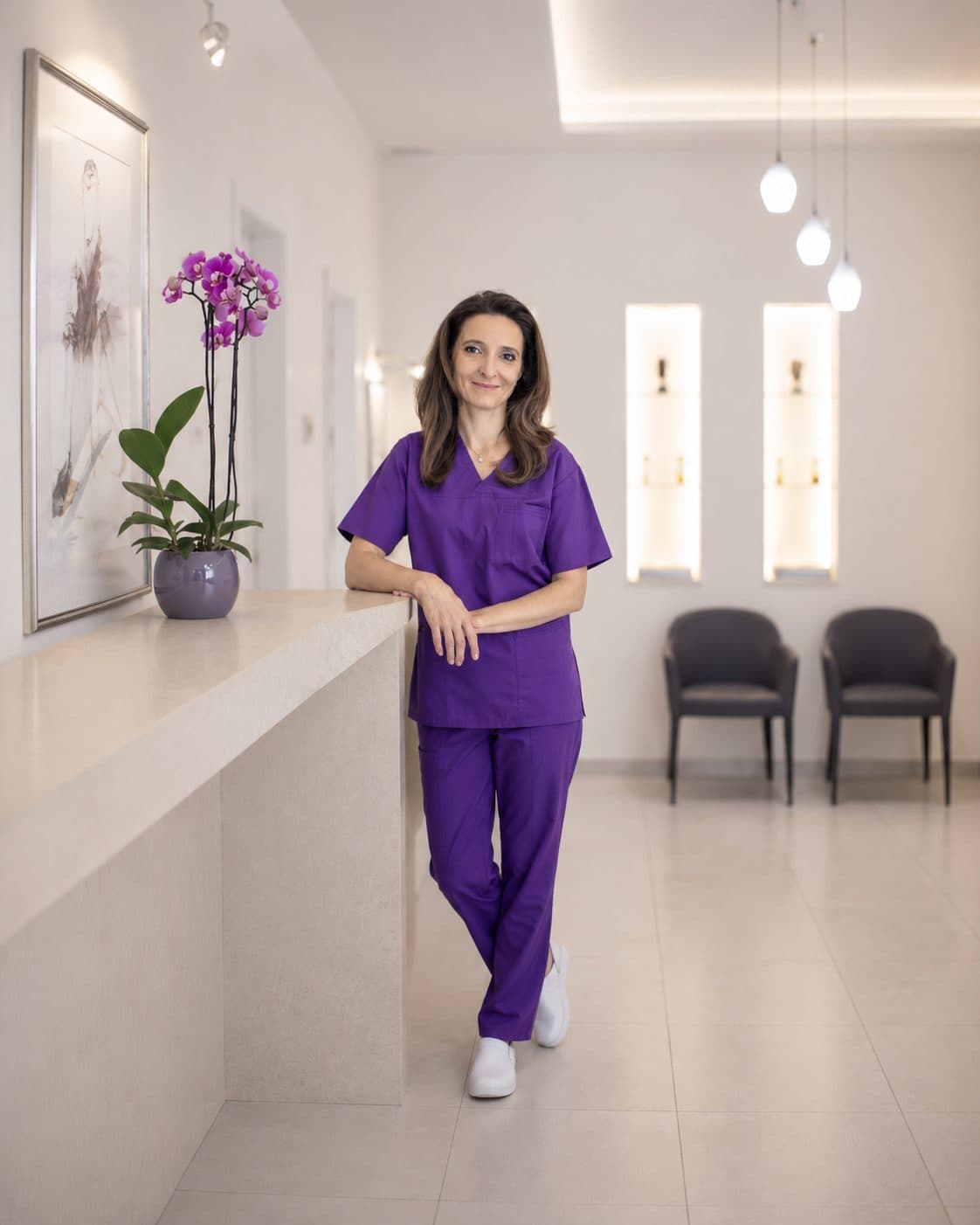
Dr. Maráz Kinga
Dentoalveolar surgery specialist
Periodontal disease treatment, bone grafting, implantology
Profile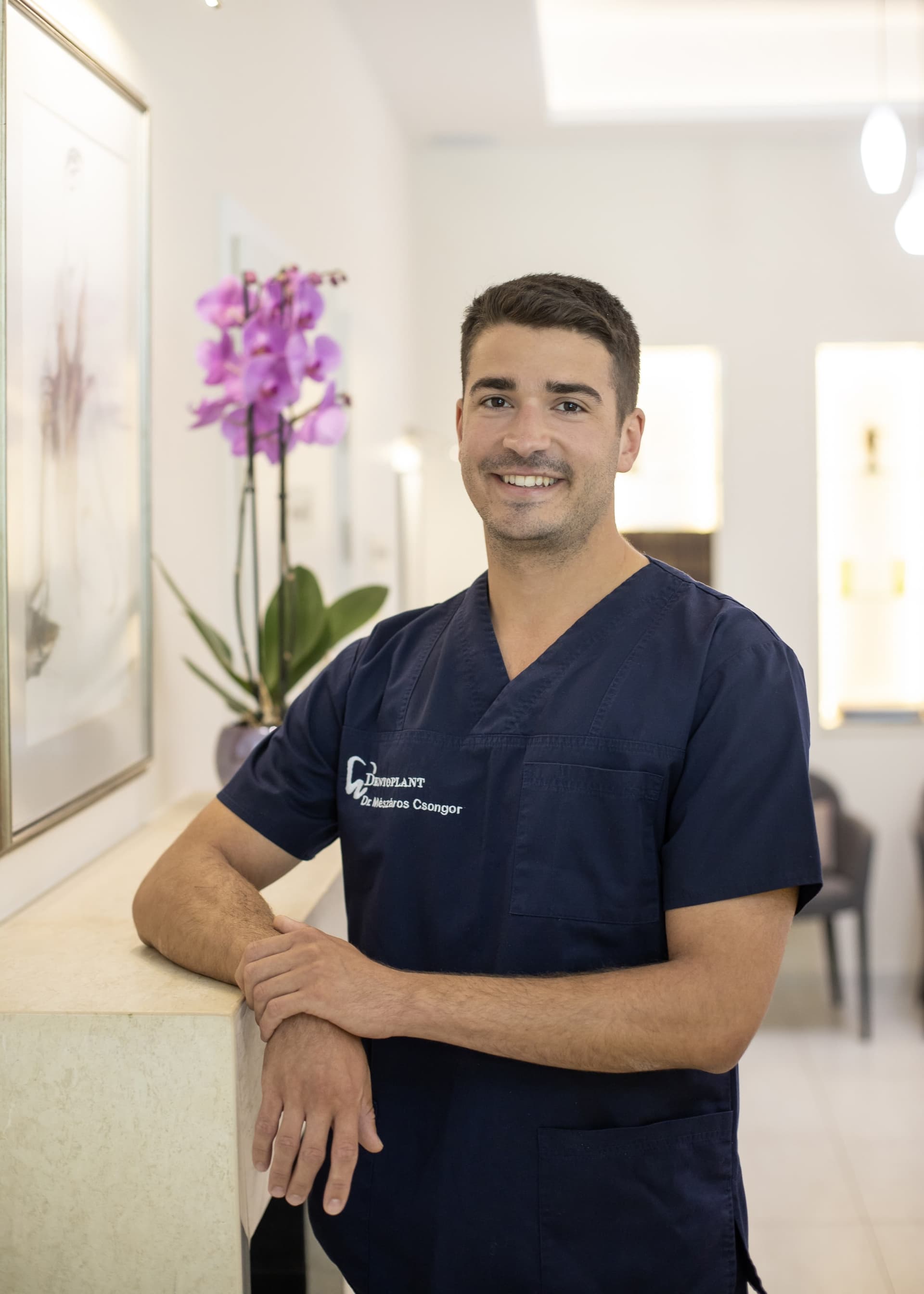
Dr. Mészáros Csongor
Dentist
Oral surgery procedures, digital dental solutions
Profile
Dr. Roszik Melitta
Anaesthesiologist
Pain relief, anaesthesia