
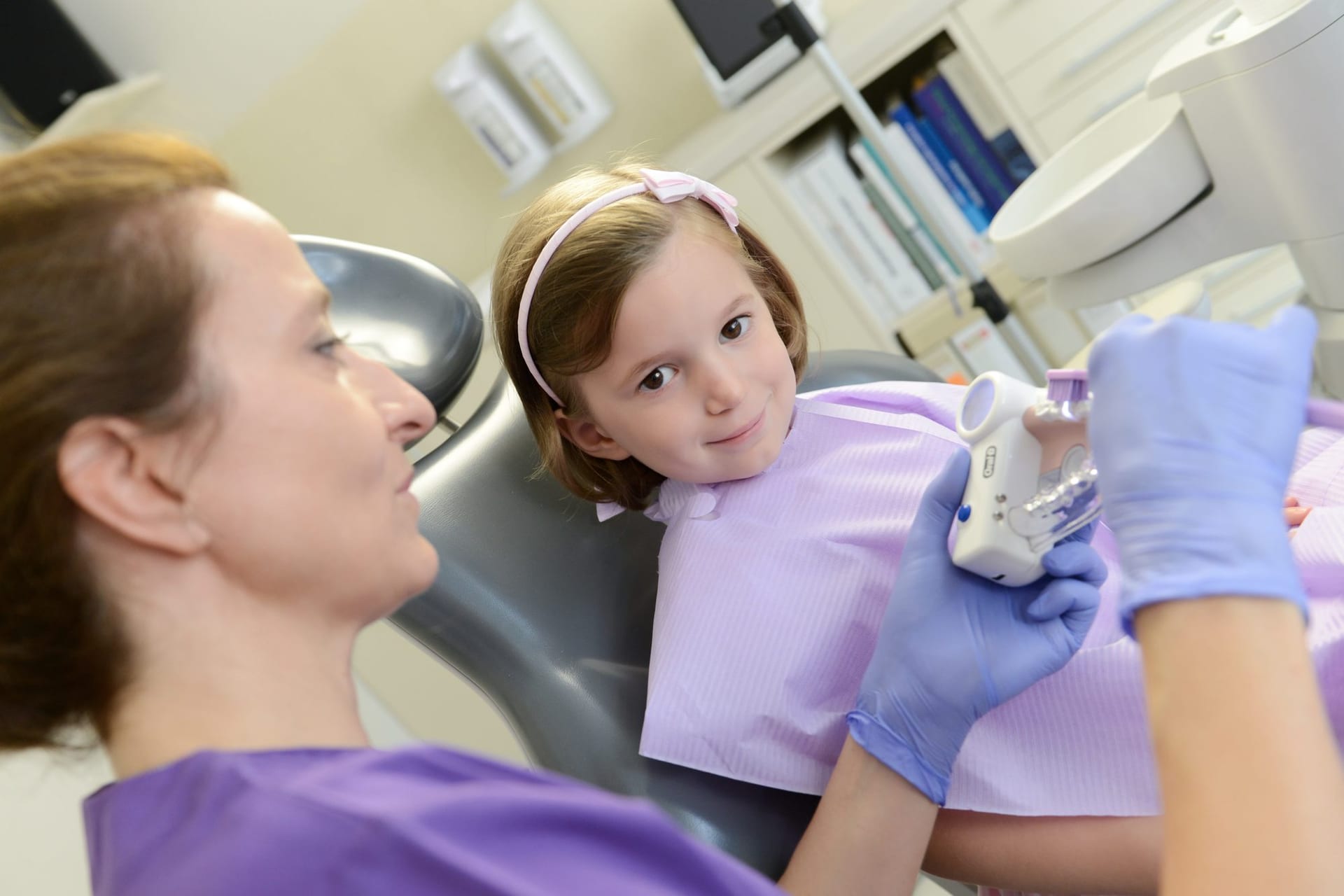
Prevention and the family dental model
We recommend regular dental check-ups for children every six months at the Dentoplant Dental Clinic in Szeged.
Numerous changes can occur in children's dentition within a relatively short time: tooth replacement, decay of milk teeth and permanent teeth, or even rapid, fast decay. Milk teeth that have begun to deteriorate must be carefully filled, since the permanent teeth around them that erupt later can also be damaged. Preserving the integrity of the milk teeth is important for the symmetrical development of the dentition and the jaws. A milk tooth lost early can lead to problems that later require orthodontic treatment.
The philosophy of the Dentoplant Dental Clinic is prevention. We believe that, with personal example and regular six-monthly check-ups, our children's dentition can also be kept healthy. A child relates to tooth brushing the way they see it from their parents — which is why we apply the family dental model: we plan the pace at which they can come to treatments together with the child, and the joint teaching of oral hygiene is especially important to us.
From what age should a child's teeth be brushed?
Education in proper oral hygiene cannot begin early enough. Just as proper nutrition begins already in the womb, proper oral care begins already in infancy. At first, during the breastfeeding period, it is enough to wipe the toothless arches with the corner of a nappy, but as the first milk teeth appear, getting acquainted with the toothbrush can begin. Our dental hygienist helps choose the toothbrush most suitable for the child's age.
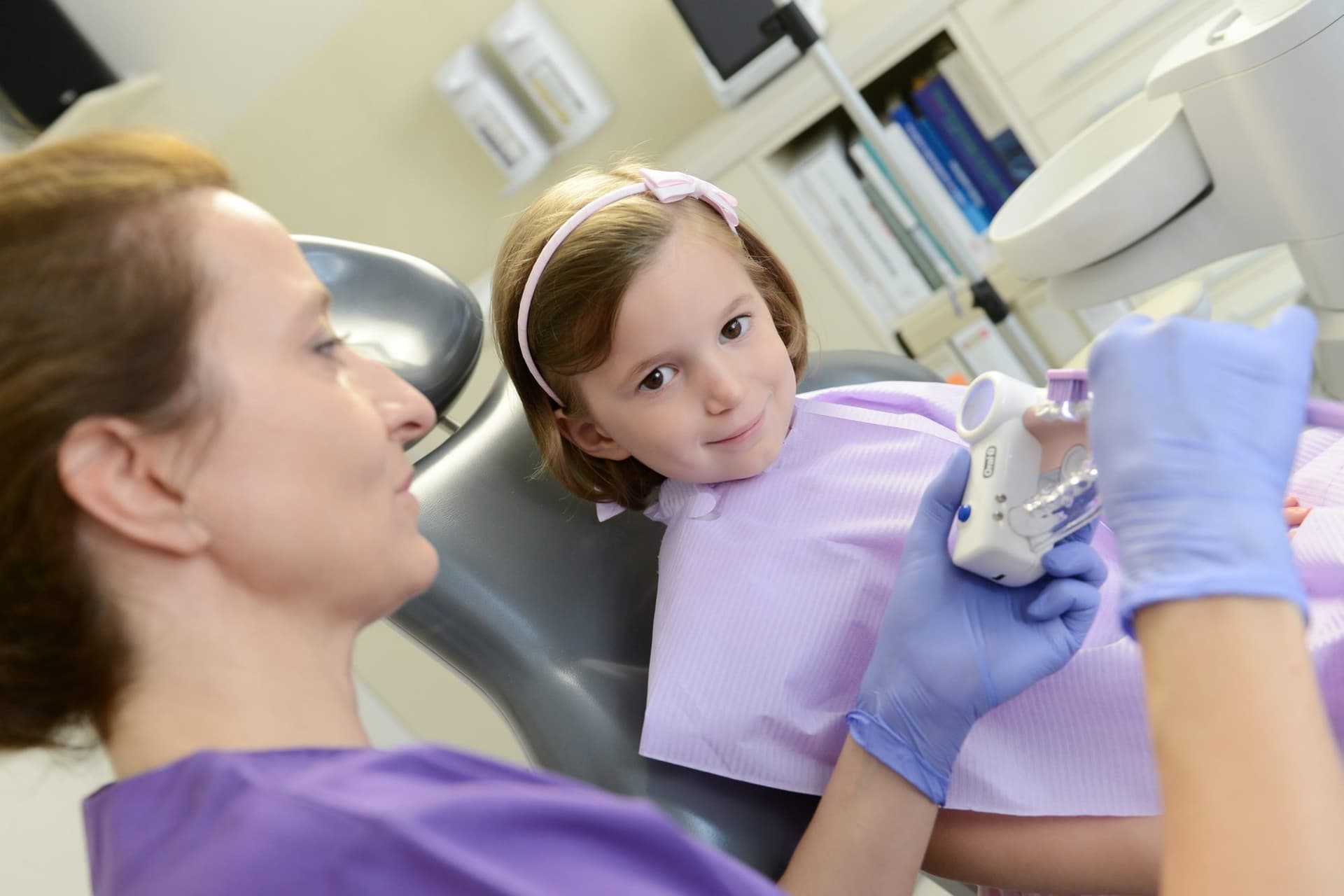
Why is the six-monthly check-up important?
The right time for the preventive fissure sealing of freshly erupted permanent molars must not be missed, and the need for orthodontic treatment must also be recognised in time. Children whose parents regularly bring them for check-ups every six months always visit us more willingly later in adulthood too. Because of the regularity, we notice cleaning mistakes or other deviations sooner in their case — so drilling the tooth can usually be prevented, or it can be managed with only minimal discomfort.
What is fissure sealing?
The creation of a protective layer that can be done on permanent molars at the earliest opportunity. Since in early childhood tooth brushing is not yet perfect and plaque often remains on the teeth, the risk fissures of the intricately grooved molars decay first. We fill these fissures on the chewing surface of freshly erupted, intact permanent teeth with a light-cured, fluoride-releasing varnish.
Note: the first fissure sealings should be done when the first permanent molar (the “six”) erupts, usually around the age of 6!
Trauma to the teeth
Every year, during the summer period, the number of children's tooth accidents increases. In kindergarten age, foot-powered ride-on toys and scooters, later the bicycle, cause classic tooth injuries. Let's wear protective equipment and a helmet — but if the accident has already happened, it is important to know what to do. If possible, see a trained dentist immediately.
We classify tooth injuries according to the standardised categorisation of the International Association of Dental Traumatology DENTAL TRAUMA GUIDELINES, and every injury is treated according to these recommendations. If a larger piece breaks off the tooth and the dentin becomes exposed, sensitivity occurs, which can even lead to the death of the tooth. If a tooth breaks in half as a result of trauma, the pulp opens immediately — in such cases the tooth must be root-treated at once. The supporting structure of teeth that have suffered a blow is damaged even if the tooth did not break off; a common complaint is pain on biting. If the teeth become slightly mobile, immediate splinting is needed.
Thumb-sucking and other childhood bad habits
One of the most common bad habits is thumb-sucking, whose prevalence can even reach 35-40%. In newborns and infants it is a natural process to get to know their environment through stimulation of the tongue and lips — however, a regular and long-lasting habit affects the development of the teeth and jaws.
4-6 hours of thumb-sucking a day can already cause tooth displacement. Classic resulting changes include an anterior open bite, upper jaw narrowing, crossbite, a gothic palate, the upper incisors tilting outwards and the lower ones inwards, and the retropositioning of the lower jaw. All this disrupts the normal bite, can interfere with chewing and aesthetics, and can also cause a speech impediment. If thumb-sucking becomes a fixed habit, it is worth weaning the child off it by about the age of 4 — at an older age, jaw and dental problems requiring an orthodontic appliance to solve are more likely to develop.
Circular milk-tooth decay (circular caries)
Decay of milk teeth occurs more easily partly because the thickness of the enamel is half that of permanent teeth. Decay can occur even within half a year to a year after the tooth erupts.
Early Childhood Caries (ECC) is, in the age range from birth to 71 months, one or more carious lesions with or without cavitation, or milk teeth lost or filled due to caries. Most often the upper incisors are affected, and in more severe cases the first milk molars. Circular caries is a fast-spreading, encircling decay that begins on the outer surface of the incisors along the gum margin and can appear as early as one year of age.
Triggering causes
External (exogenous) factors
Internal (endogenous) factors
As for its therapy, an important step is changing the cariogenic diet. In the early stage they can also be treated with adhesive techniques (fissure sealant or flowable composite). Those in a more advanced state can be treated with fillings, build-ups, possibly a crown, and as a last resort extraction takes place — in which case it is especially important to consider the effects on learning to speak and to ensure space maintenance for the permanent teeth erupting later.
Lower milk teeth growing — “the teeth are in two rows”
We get many questions because “the child's teeth are in two rows at the front”. There is no need to be alarmed: most often it is a natural tooth-replacement process. The lower permanent front teeth approach the milk teeth from the inside, from the tongue side — so it can happen in the mouth of a child around 6 that the two lower permanent front teeth have already erupted on the tongue side while the lower milk front teeth are still in place. The milk teeth loosen and fall out within weeks or months, and the tongue and growth movements nicely arrange the permanent front teeth into place.
Bring your child in with confidence
Facts and myths about tooth replacement
Milk teeth play a vital role in early childhood: chewing solid food, speech, jaw development, and holding space for permanent teeth.
Around age 6 they loosen and fall out. Children have 20 milk teeth and adults 32 permanent teeth — so new teeth erupt as well as replacements.
How does childhood tooth replacement proceed?
It starts with loosening of the lower incisors at 6–7. By then the first permanent molars (the ‘sixes’) have often already erupted, without a milk tooth falling out first — parents may think they are still milk teeth.
Permanent teeth at risk
New permanent molars can decay quickly in deep fissures. The first molars are most at risk. Replacement starts with the central incisors, then laterals, canines and premolars, finishing around age 12 with the second molars. Wisdom teeth may appear after 17. Prevention: regular check-ups, tartar removal, brushing and fissure sealing.
May we wiggle the tooth, or leave it to fall out?
A very loose milk tooth can irritate the gum. Wiggle it so the gum recovers and the permanent tooth can erupt.
The permanent tooth has erupted but the milk tooth is still there. Extract it?
If the milk tooth is loose and only a small part of the permanent occlusal surface has appeared, wait a few weeks. If at least half the crown has erupted or the axes do not match, remove the milk tooth soon so the permanent tooth does not erupt in the wrong direction.
Newly erupted permanent teeth do not fit the row perfectly. When to start braces?
Permanent teeth are already adult-sized; the jaws are not. Mild crowding at 6–8 may resolve with growth; marked discrepancy warrants orthodontics. A first screening around age 7 is useful. Lower permanent incisors erupting from the tongue side may need milk-tooth removal so the tongue can align them.
Permanent enamel is not as white as milk teeth. Why?
The enamel structure differs. Milk teeth are more bluish-white, permanent teeth yellowish-white. The contrast is natural; once milk teeth are gone, the permanent teeth look whiter.
The most common accompanying symptoms
- Irritated, swollen, sensitive gum around a long-loose tooth — extraction often relieves it at once.
- Increased saliva, sometimes inflammation at the corners of the mouth.
- Gingiva still covering part of the erupted tooth — hygiene remains important.
- If a milk tooth is lost and the permanent tooth does not appear for a long time, check for a tooth germ; if missing, see an orthodontist.
The pace is individual, often around school age. If you are unsure, a specialist examination gives a clear picture.