
Root canal treatment to save teeth
Root canal treatment is a procedure aimed at saving the tooth, which we perform when the pulp (the dental nerve) has suffered irreversible damage.
The need for root canal treatment can be caused by numerous conditions: advanced, deep decay, tooth trauma, inflammation associated with periodontal disease, abrasion, erosion. In a clinic providing comprehensive dental care, it is essential that root canal treatments are carried out by a well-trained team, because these teeth often become the abutments of later restorations. At the Dentoplant Dental and Implantology Clinic, our colleagues perform root canal treatments with modern pain relief, according to the highest professional guidelines.
Toothache and pulpitis
In the case of pulpitis, the tooth reacts to cold or hot stimuli with sharp pain lasting for minutes; in an advanced process, spontaneous pain occurs — a typical example is pain that appears at night and does not respond to painkillers. However, the tooth can also be symptom-free if the pulp has already died: in this case the bacteria grow undisturbed and sustain a chronic inflammation that can spread through the root tip to the tissues around the tooth. Acute apical inflammation can even lead to an abscess, with serious complications if left untreated. Chronic apical inflammation is usually low in symptoms — it is often only diagnosed on an X-ray. These dead teeth can be the starting point of focal disease.
The dental focus
The dental focus is a chronic inflammatory process that hardly causes local symptoms — pathogens and toxins can also enter the body from it. The most common secondary, focus-related diseases: patchy hair loss, eczema, allergic rashes, eye inflammations, joint inflammations, vascular inflammations, kidney diseases.
The course of root canal treatment
- 01
Opening and creating access
After appropriate anaesthesia, trepanation of the tooth and creating an opening in the crown so that the pulp chamber and the entrances of the root canals become sufficiently visible and accessible. - 02
Rubber dam isolation
By placing the rubber dam, we prevent further bacteria from the saliva entering the root canal, provide dry conditions for the root filling, and can carry out the whole treatment cleanly and precisely. - 03
Mapping the root canal system
With X-rays and, if necessary, a CBCT 3D scan, we clarify the course of the canals. With modern CBCT we can take a targeted image of the given tooth, so the radiation exposure is also significantly lower. - 04
Determining the working length
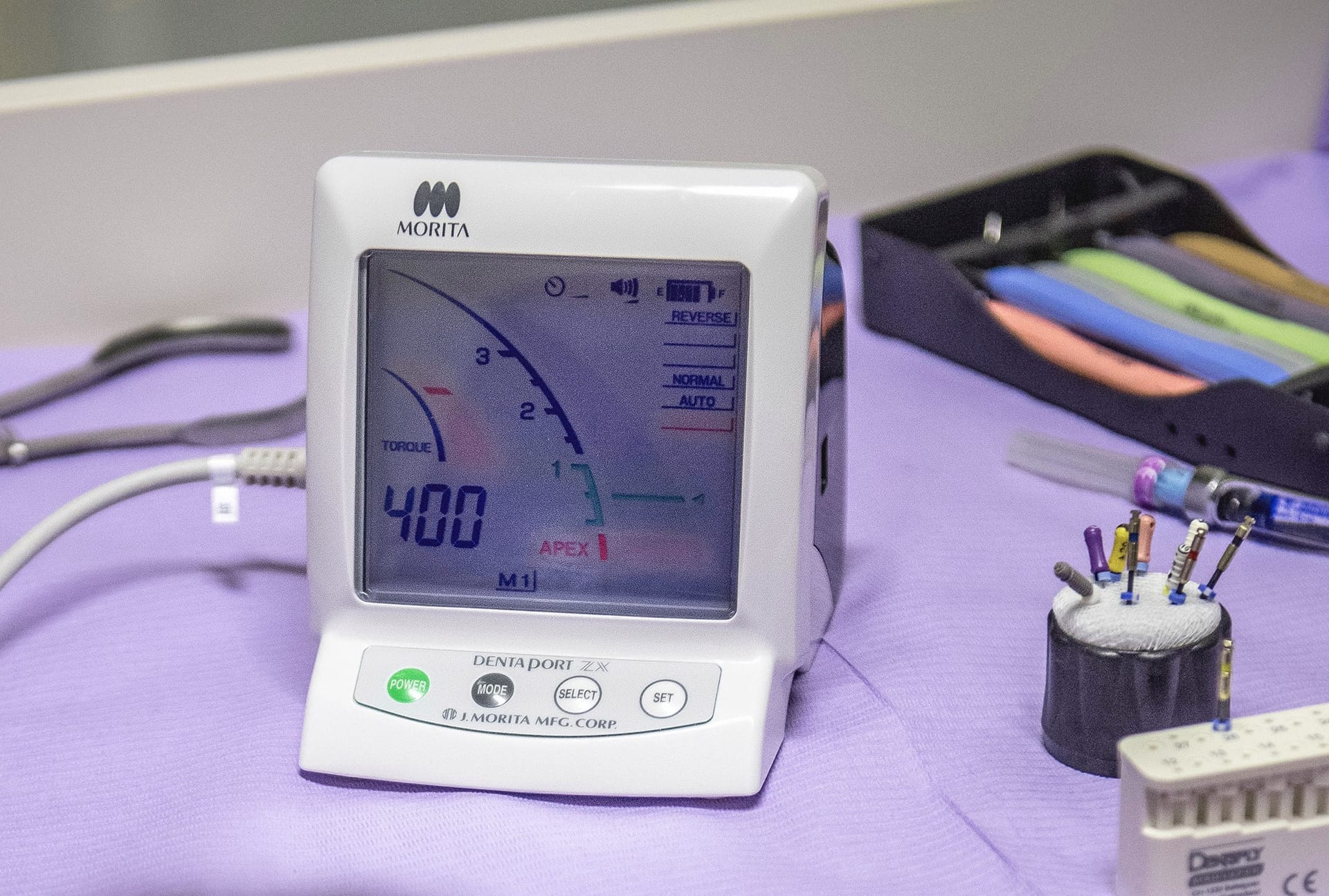
We determine it with a local X-ray (file control) and an electronic apex locator, which measures the constant electrical impedance between the soft tissues of the mouth and the apical periodontium. For this purpose we use the modern Morita DentaPort ZX© system. - 05
Canal shaping and cleaning
With modern Endowave© and ProTaper Next© rotary files, we clean the root canal system efficiently and quickly. We complement the mechanical work with thorough chemical irrigation, so that areas not reached by the instruments and the accessory canals are also disinfected. - 06
Interim care
Until the next session, we place a disinfecting, medicinal calcium hydroxide paste into the canal system and provide the tooth with a temporary filling. - 07
Root filling (lateral condensation)
Using gutta-percha points and a sealer, checked with a point-control X-ray, we fill the canal. Compacting with a spreader, we place additional points, then check the result with another X-ray. - 08
Restoration
A root-treated tooth loses its blood supply and therefore becomes more prone to fracture — it must be reinforced. A fibreglass-reinforced post and composite, or an aesthetic filling / inlay / crown provides a durable, well-sealing restoration.
Retreatment of a root filling — the tooth's last chance
Retreatment is the repetition of previously performed, unsuccessful root canal treatments — it is the last line of defence before resorting to surgical means to save or remove the tooth. It usually means replacing the old, poorly sealing or incomplete root filling.
We remove the old root filling and, over several repeated treatments, try to resolve every factor that may have caused the failure — an undiscovered root canal, insufficient shaping and irrigation, incorrect working length. Only after this do we create the new root filling. If the tooth is still painful or swollen 2 months after the root filling, or an apical lesion develops later, retreatment is unavoidable.
When is it recommended even for a symptom-free tooth?
We also consider retreatment if the patient is symptom-free but the X-ray shows an inadequate root filling and we want to use the tooth as an abutment for a restoration, or we are planning an implant next to the tooth. In such cases replacing it is especially important, so that a recurring inflammation does not endanger the later, expensive restoration or implant.